.jpg)
.jpg)
.jpg)
.jpg)
.jpg)
.jpg)
.jpeg)
.png)
.png)
.png)
.png)
.png)
.jpeg)
.jpeg)
.jpg)
%2520(1).png)


.avif)


.png)
.png)



.png)
![Agent Server [1/3]: Where Enterprise AI Agents Live, Work, and Scale](https://cdn.prod.website-files.com/67bef0c56c3781a827a0f375/69c14b6f967d2ae5279adcea_690e4d0f068d3ec27aea7ae0_123%2520(1).png)
![Agent Server [2/3]: Where Should Your Agent Server Run?](https://cdn.prod.website-files.com/67bef0c56c3781a827a0f375/69c14b6f967d2ae5279adcf0_690e646b6e0366d090fbc37f_wdxczxgr-1.png)
![Agent Server [3/3]: Agent Access Control Explained: RBAC, Caller Limits, and Safer A2A](https://cdn.prod.website-files.com/67bef0c56c3781a827a0f375/69c14b56c87a1735a82bac8d_69132a45740300abc320bc7f_Cover_%2520RBAC%2520for%2520Agents%252C%2520Done%2520Right2%2520(1).png)
.png)
.jpeg)
.png)
%25201%2520(1).jpeg)

%25201%2520(1).jpeg)
.jpg)
.jpeg)
August 12, 2026
Why AI Agents are Replacing Traditional Data Engineering
.jpg)
.jpg)
.jpg)
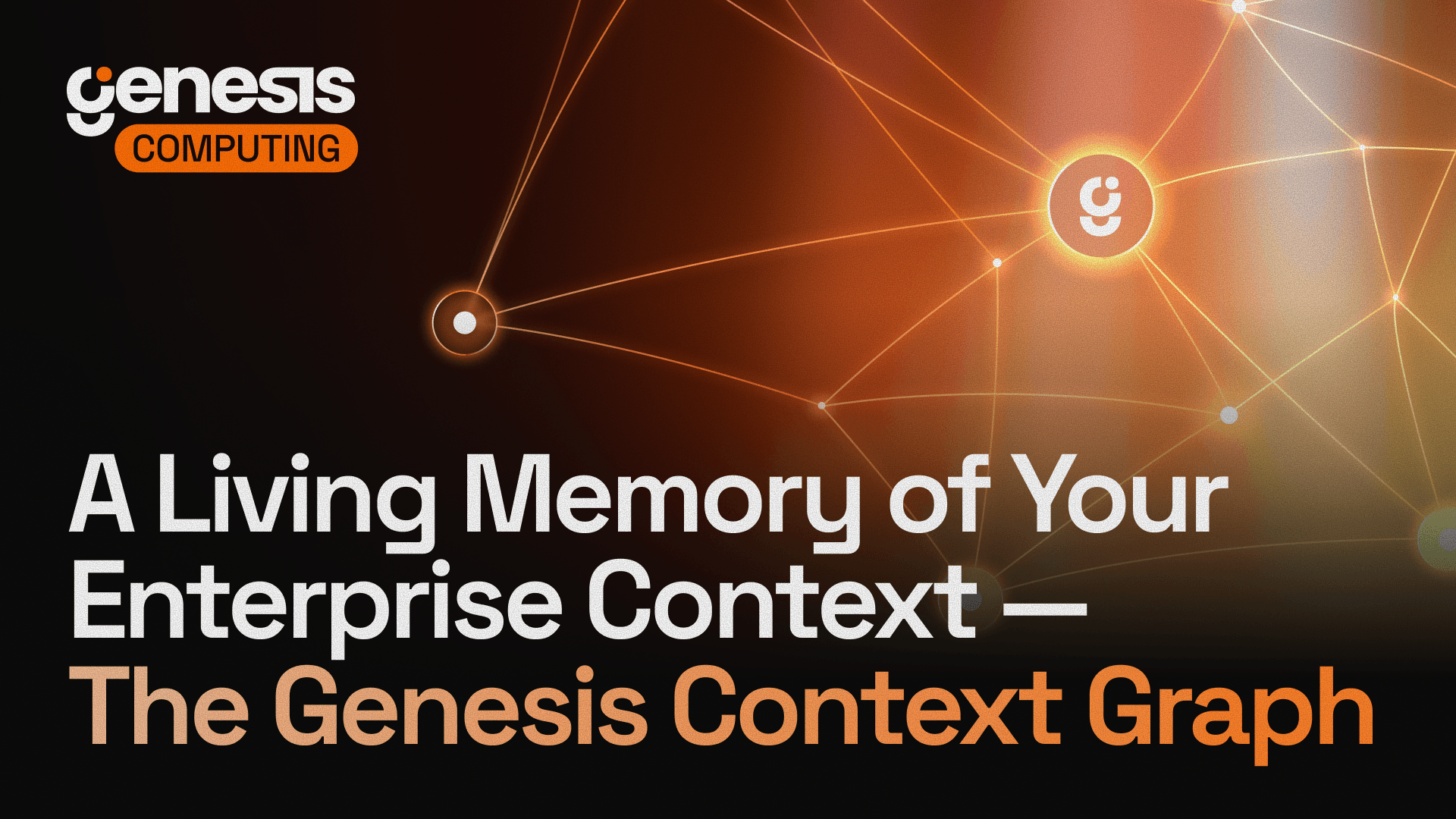
TL;DR: An AI agent is only as good as the context it has access to. The Genesis Context Graph crawls every connected system to build a comprehensive picture of a client's data domain before a mission ever runs. That picture combines two kinds of knowledge: what can be observed by connecting to systems, and what lives in people's heads as undocumented judgment calls. Genesis is built to capture both.
Give any agent access to your systems and ask it to do something, and the quality of that work depends entirely on the context it has. Think about a very smart engineer straight out of MIT joining your team. They might be genuinely brilliant, and they will still have no idea about the domain they are working in or the state of your existing data. Intelligence without context produces confident, wrong answers just as easily as it produces useful ones.
The Genesis Context Graph is our answer to that problem. It is how we collect a client's data state, understand it, and use it every time we run a mission. See it described in more detail in: Why AI Agents That Have Context First Build Better Pipelines.
Genesis connects to every system a client has, and crawls them. In Snowflake, that means the entire schema, every table and every column. For anything outside Snowflake, the goal is the same: build the most comprehensive picture possible of a client's domain. We've shown this in practice in 40 Minutes to Reverse-Engineer a Legacy Data Warehouse, including the ghost artifacts nobody on the team remembered still existed.
This crawling step is not a nice-to-have preamble before the "real" work starts. It is the work that makes everything downstream trustworthy. An agent that skips it is making the same mistake as a new hire who starts writing code before reading any documentation.
What we found, working through this problem, is that a client's knowledge graph really breaks down into two categories. The first is what we call the observable universe: everything we can determine just by connecting to the database, the code, and the other systems already in place.
The second category is harder, and it is the one most tools ignore. A meaningful chunk of institutional knowledge never gets written down. It lives in people's heads, and when it does get captured at all, it lives in scattered docs, Slack threads, and hallway conversations rather than structured metadata. Research from McKinsey on scaling agentic AI makes a similar point: multi-agent workflows depend on shared knowledge graphs and consistent, interoperable data. Without a shared semantic foundation, agents can act on incomplete or conflicting interpretations of the same information.
We've started exploring how to capture both kinds of knowledge at once. Systematic knowledge from connected systems and expressed knowledge that users share directly through Genesis. As diginomica's coverage of context graphs puts it, this kind of institutional memory captures how a process happens in practice, including the exceptions and precedents that never made it into any formal record.
Every mission we've walked through elsewhere on this blog runs against this context graph. That is the difference between an agent guessing at what a column probably means, and an agent that already knows. It read the schema, the dbt model documentation, and whatever internal notes a data engineer left behind. We touch on the related challenge of keeping that context coherent across long-running work in Context Management: The Hardest Problem in Long-Running Agents, and on why raw context volume alone isn't the answer in Tokenflation Is a Symptom, the Cure Is Context-Aware AI Architecture.
This is also the reasoning Gartner pointed to in recognizing Genesis as part of its "Data Engineering 2.0" research, which found that most organizations' current practices cannot effectively support AI use cases. This is largely because the semantic context AI systems need is missing from how data has traditionally been modeled.
What is the Genesis Context Graph? It's how Genesis collects, understands, and uses a client's full data state, including schemas, pipelines, BI tools, and documented or undocumented institutional knowledge, before running a mission.
What systems does the Context Graph crawl? Snowflake (full schema, tables, columns, views, procedures, functions, streams, pipes), Git repositories (SQL, Python, and dbt project files), Salesforce (objects and relationships), and Tableau (workbooks and data source bindings), and more.
Why does undocumented knowledge matter for AI agents? Because a meaningful share of how an organization actually works lives in people's heads rather than in system metadata, and an agent without access to it will make confident but wrong assumptions.
How does the Context Graph affect mission accuracy? Missions run against the context graph rather than a blank slate, so agents work from an existing understanding of the domain instead of guessing at what data means.


.jpg)
.jpg)