.png)

![Agent Server [2/3]: Where Should Your Agent Server Run?](https://cdn.prod.website-files.com/67bef0c56c3781a827a0f375/69c14b6f967d2ae5279adcf0_690e646b6e0366d090fbc37f_wdxczxgr-1.png)

.jpg)
August 20, 2026
Coolest Vendor Innovations in Data Management
.png)
.jpg)
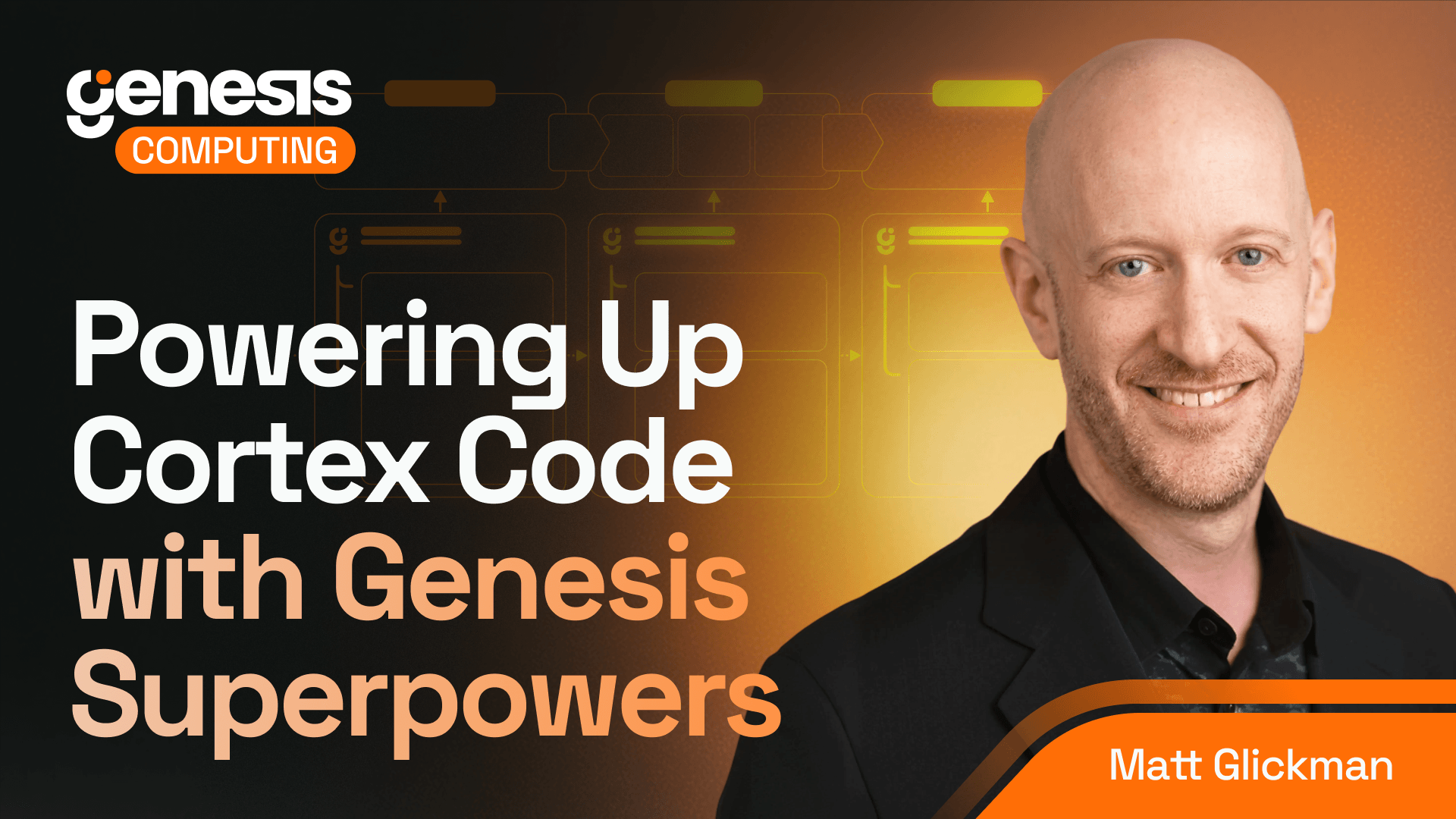
TL;DR: Matt Glickman, co-founder and CEO of Genesis Computing and former Goldman Sachs and Snowflake executive, joined Al Martin on IBM's Making Data Simple podcast to make an uncomfortable argument: the constraint in enterprise AI has moved, and most organizations are still measuring the old one. Frontier models crossed a capability threshold in early 2026. Verification did not. Human code review, the control most data teams still name when asked how they manage AI risk, only ever functioned because humans typed slowly. This post covers what replaces it, what a blueprint is, where Genesis actually sits on the autonomy spectrum today, and why regulated industries are moving first this time.
Frontier models crossed a threshold where they could hold multi-step, high-context work on course without drifting. Before that point, an agent asked to run a migration or build a data product from raw sources would fail within a few steps. After it, given the right harness, the same class of work became completable.
Matt places the window between roughly November 2025 and January 2026, citing the Claude 4.6 to 4.7 cutover followed by the GPT-5 family. His framing is that this is when the technology started producing real return rather than impressive demos.
"As long as we provided the right harness, the right steps, and the right context management, these things understood the problem and stayed on course."
The operative word is harness. The models became capable of doing the work. They did not become capable of managing themselves through it, and they did not become capable of proving they did it correctly. That second gap is the one nobody has closed, and it is where the rest of this conversation goes.
Code review worked because it was rate limited by human typing speed. Agents removed that limit, and the volume of change now moving through enterprise pipelines exceeds what any review process was designed to absorb.
This is the sharpest claim in the episode and it deserves to be stated without hedging:
"There's just no way humans can review code they didn't write."
Matt's argument is structural rather than cultural. Reviewing someone else's code was always difficult in both directions: the reviewer lacks context, and the author feels second guessed. It functioned anyway because throughput was bounded. He notes that GitHub itself is straining under the volume agents now produce.
In data engineering, he argues the problem is not difficult but effectively impossible:
"There's no way a human is going to understand: wait a second, if the agent makes this change... I'm supposed to understand the impact as it compounds across the rest of my data estate, with side effects I never even thought about, in code I didn't write."
This distinction matters operationally. Reviewing application code in a bounded repository is hard. Reviewing a change to a data estate means tracing lineage across warehouses, transformation layers, orchestration, reporting, and downstream consumers, most of which is undocumented and much of which lives only in the heads of people who may have left.
For anyone in a regulated environment, there is a second-order problem worth sitting with. If your documented control for change management is human review, and human review is no longer proportional to the volume and complexity of change, then the control described in your process documentation and the control actually operating in your environment have diverged. That gap surfaces at audit, not before.
Matt uses self-driving as the analogy, and it is more precise than the usual version. Failure is not the moment you hand over control. It is that once you have handed it over, re-engaging is nearly impossible.
"Once you let go, you're not going to be able to re-engage in time."
His conclusion is not that teams should reinstate review by force. It is that the checking has to move into the system.
A blueprint is a defined sequence of steps for a complex data engineering workflow. Rather than handing an agent an entire objective, the platform releases one step at a time and validates the output of each before issuing the next.
The design exists because of a behavior Genesis observed early and now treats as a given:
"Agents, like humans, are going to be lazy. They'll do the minimum amount of work they think is necessary for the task."
Given an instruction like "migrate SAP to my cloud warehouse," an agent will find the shortest path it believes satisfies the request, and it may or may not tell you what it skipped. A blueprint decomposes that into gradeable units. The first step is not the migration. It is: connect to the source system, catalog every asset and every consumer of that system, and produce the catalog as an artifact. A discrete goal with a checkable output.
Matt's description of the alternative is worth keeping in mind when evaluating any agentic tool: without step decomposition, you are saying "here's a big task, YOLO," and hoping.
There is a related failure mode most people building with agents have now hit personally. Al Martin describes asking for a 300 line output and receiving fifty pages, with the model explaining partway through that it knew about the limit and had decided the work justified exceeding it. Matt's read is that this is a consequence of optimization rather than a defect:
"An AI you've optimized to please us and to solve problems creatively is going to start assuming that our prompts are guidance, not rules."
Constraints that live in the prompt are suggestions. Constraints that live in the harness are constraints. That is the entire design argument for blueprints in one line.
Matt places Genesis, and the industry, in the middle column. The right column is gated on validation capability that does not exist yet.
Genesis runs a second agent as a judge to confirm a step produced a real and complete artifact. Matt is direct that this improves accuracy without solving the underlying problem, because the validator can be as lazy as the worker and because agents are unusually good at impressing one another.
“You cannot depend on the AI to judge itself fairly. Its goal is to impress us, and it’s equally great at impressing other agents.”
He draws a pointed contrast with the frontier labs. Model releases keep accelerating because those labs closed their own loop: test, reinforce, test again, with prior generation models helping train the next. That loop works because the environment is bounded and correctness is measurable.
Enterprise data estates are neither. State is complex, dependencies are undocumented, and one workflow’s change propagates into systems its author never saw. Matt’s position is that this loop has not been closed by anyone, and that closing it is a prerequisite for autonomy rather than an optimization layered on top.
This is the practical role of the Genesis Context Graph. Crawling the estate across databases, repositories, documentation, and pipelines, then mapping the dependencies between them, is not a discovery feature. It is the substrate that makes impact analysis possible at all, because most of that knowledge was never written down.
It goes to the model provider, in plaintext. Matt’s argument is that enterprises have quietly accepted a trust boundary for inference that they would never accept for storage.
The distinction is precise. Trusting a hyperscaler with encrypted data at rest is a low risk position, because the provider would have to steal your keys to read it. Inference is a different bargain:
“We’re literally sending things in the clear. The AI is reading it in the clear, not encrypted.”
The timing is not incidental. Palantir CEO Alex Karp made a version of this argument on CNBC in July 2026, contending that enterprises are paying for tokens while handing over the proprietary decision logic that constitutes their competitive advantage. The critique moved markets and reframed the enterprise AI debate around ownership rather than capability. Matt’s framing predates the news cycle and lands in the same place: there is an incentive mismatch between a buyer paying for value and a seller whose business model is a stronger model.
He extends it somewhere less discussed. Even organizations that lock down their systems face a leakage channel they cannot close, which is people. Frontier labs are paying former enterprise employees to explain how their institutions actually operate. Documents and code stay behind. Judgment does not.
“Whatever you learned, that’s yours. So these frontier companies say, ‘Great, you worked at X company, come to us, we’ll pay you a crazy amount of money per hour to just talk to our models.’”
His conclusion is that enterprises should be accruing operational knowledge as an owned asset rather than renting intelligence that absorbs it. That is the strategic case for running agents inside your own environment rather than shipping context outward.
At delegation, with humans gating production. Matt says so without softening it.
“Right now, the humans are still in the driver’s seat.”
Genesis fits into the SDLC an enterprise already has. Agents work in a development environment, produce changes, get them tested, and submit a pull request for human review before anything reaches production. His caveat is worth quoting to anyone evaluating agentic tooling: “if you have a crappy SDLC process, this is not going to be fun.” Agents inherit your process discipline. They do not supply it.
For a buyer, a vendor naming the capability it does not yet have is the more credible signal, not the less. It means the other claims can be checked.
Because they carry the most data complexity, the heaviest manual data labor, and the longest standing inability to hire people who understand business, data, and technology simultaneously. It is the inverse of the cloud adoption curve, where financial services and healthcare moved last.
Matt’s read is that the same complexity that made cloud adoption slow makes agentic adoption urgent. These organizations have the most intricate data flows, the largest manual burden, and until now there was no better answer available.
He adds a competitive dynamic worth taking seriously. One Genesis customer is operating as an AI-first company outright, betting it reaches full autonomy before incumbents can transform. In regulated markets he frames the next few years as a race between legacy institutions and newcomers, and notes that far more customers are leaning in inside regulated industries than outside them.
The customer evidence follows the pattern. A New York hedge fund replaced bespoke ingestion with a multi-agent pipeline that absorbs schema change. Globe Telecom decoupled delivery speed from headcount.
Learn the business. Matt’s argument is that the technical layer is commoditizing fastest, the data layer is close behind, and what survives is the ability to connect a technology to a business problem.
“The tech is being commoditized. The data skills are also being significantly disrupted, if not commoditized. What’s going to remain is understanding how these technologies can solve a business problem.”
This traces back to what he saw at Goldman Sachs, where the firm defined a role called a strat for people who held business, data, and technical knowledge in one head, and gave them a unified platform. That combination is what let Goldman re-model its view of the world quickly in 2007 and 2008 while other institutions could not.
His practical advice is deliberately unglamorous: take on a project at work, take on a project at home, and do not wait for your employer or your university to teach you. The technology does not reason the way a person does, and that is not learnable from the sidelines.
“The longer you wait, the harder it’ll be to jump in and catch up.”
On jobs he is careful. Nobody currently employed loses their role, and existing engineers become substantially more capable. The change appears at the entry point, in hiring that never happens. That concern is measurable. Stanford’s Digital Economy Lab, analyzing ADP payroll records covering millions of US workers, found that early career workers aged 22 to 25 in AI-exposed occupations saw a 16% relative decline in employment while employment for experienced workers in the same occupations held steady. The researchers have since expanded that work into a live dashboard built with ADP Research.
Asked what podcast hosts should ask more often, Matt lands on exactly this: what happens to an education system still operating on the promise that a degree and debt produce a job, in a market where the entry rung has been removed.
The argument worth carrying out of this episode is not that agents are getting more capable. Everyone concedes that. It is that the industry has been measuring the wrong constraint.
Capability crossed its threshold in early 2026. Verification did not. And because the review layer most organizations still count as their control was only ever a function of how fast humans could type, the gap is not theoretical. It is already open, in production, inside companies that believe someone is still checking.
Matt’s position is that the platforms that win will be the ones that close the validation loop inside complex environments, not the ones that generate the most output. That is a harder problem than autonomy, and a considerably more valuable one.
“If you’re at the place where you’re pushing the limits, starting to let go, and finding it’s hurting, reach out.”
Listen to the full episode of Making Data Simple with Al Martin and Matt Glickman on YouTube, Apple Podcasts, or Spotify.
What is an autonomous data engineering agent? An autonomous data engineering agent is a system that monitors a data environment, identifies work, and executes multi-step data engineering tasks such as migrations, pipeline construction, and data product creation without being directed at each step. It differs from a copilot in that a copilot waits for human instruction on every action, while an autonomous agent operates in the background and escalates to a human only when its confidence is low.
What is a blueprint in Genesis Computing? A blueprint is a defined sequence of steps for a complex data engineering workflow. Rather than giving an agent an entire objective at once, Genesis releases one step at a time and validates the output before issuing the next. The design exists because agents default to doing the minimum work they believe satisfies a request.
Why can’t humans review AI-generated code? Code review was rate limited by human typing speed, and agents removed that limit. Reviewing code you did not write was always difficult and only functioned because output volume was bounded. In data engineering it is harder still, because a reviewer would need to trace how one change compounds across an entire data estate, including undocumented dependencies and side effects.
Can one AI agent validate another AI agent’s work? Partially. Genesis uses a judge agent to verify that a step produced a valid artifact, which improves accuracy. But the validating agent can be as lazy as the working agent, and agents are effective at impressing one another. Independent validation of change impact in complex enterprise environments remains unsolved industry-wide.
Is Genesis Computing fully autonomous today? No. Genesis operates at a delegation stage with humans in the loop. Agents work inside a development environment, produce tested changes, and submit them as pull requests for human review. A human still makes the decision to push to production.
Will AI agents replace data engineers? No one currently employed loses their role, and existing data engineers become significantly more capable. The change appears at the entry point, in hiring that does not happen. Stanford’s Digital Economy Lab found a 16% relative employment decline for workers aged 22 to 25 in AI-exposed occupations while employment for experienced workers remained stable.
Why are regulated industries adopting agentic AI faster than they adopted cloud? Financial services and healthcare carry the most data complexity, the heaviest manual data labor, and the longest standing inability to hire people who understand business, data, and technology together. IP protection is also a driver, since regulated firms are more attentive to where proprietary context goes, which favors platforms running inside the customer’s own environment.
Making Data Simple is hosted by Al Martin, Worldwide VP of Technical Sales at IBM. The show covers data, AI, leadership, and enterprise technology through conversations with practitioners, researchers, and founders, and has run for more than 300 episodes. New episodes publish weekly on Apple Podcasts and Spotify.
Also referenced in this episode: The Singularity Is Near by Ray Kurzweil, which Matt names as the one book every technology leader should read.
Matt Glickman is co-founder and Chief Executive Officer of Genesis Computing. He spent more than two decades at Goldman Sachs leading data and analytics teams, including through the 2008 financial crisis, then joined Snowflake to lead product management and launch the Snowflake Data Marketplace. He co-founded Genesis Computing in 2024 with Justin Langseth. LinkedIn
Genesis Computing is the agentic data engineering platform. Genesis deploys pretrained autonomous AI data agents securely inside enterprise environments across Snowflake, Databricks, AWS, and Azure, using blueprints for repeatable multi-step workflows and the Genesis Context Graph for enterprise-wide context. Genesis was recognized in Gartner’s “Data Engineering 2.0” research (G00852814, April 2026).
.jpg)
.jpg)

.jpg)
.jpg)
.jpg)

.jpeg)
.png)
.png)
.png)
.png)
.png)
.jpeg)
.jpeg)
.jpeg)
%2520(1).png)
.jpg)

.jpeg)
%25201%2520(1).jpeg)

%25201%2520(1).jpeg)
.jpg)
.png)
.jpeg)
.png)
.png)
.avif)




![Agent Server [1/3]: Where Enterprise AI Agents Live, Work, and Scale](https://cdn.prod.website-files.com/67bef0c56c3781a827a0f375/69c14b6f967d2ae5279adcea_690e4d0f068d3ec27aea7ae0_123%2520(1).png)
![Agent Server [3/3]: Agent Access Control Explained: RBAC, Caller Limits, and Safer A2A](https://cdn.prod.website-files.com/67bef0c56c3781a827a0f375/69c14b56c87a1735a82bac8d_69132a45740300abc320bc7f_Cover_%2520RBAC%2520for%2520Agents%252C%2520Done%2520Right2%2520(1).png)


.png)


.jpeg)