
%25201%2520(1).jpeg)
.jpeg)
.jpg)
August 20, 2026
Coolest Vendor Innovations in Data Management
.png)
.jpg)
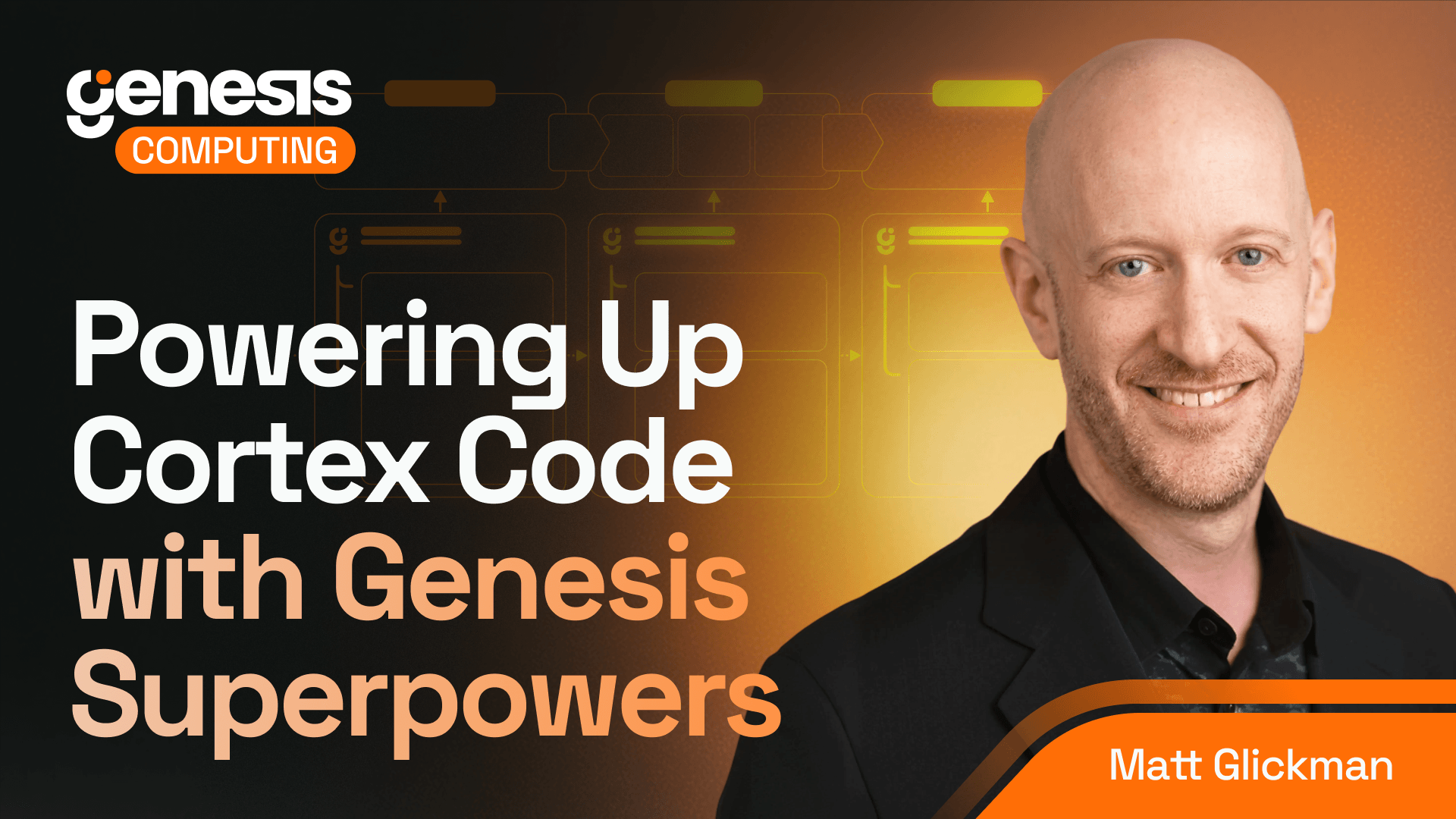
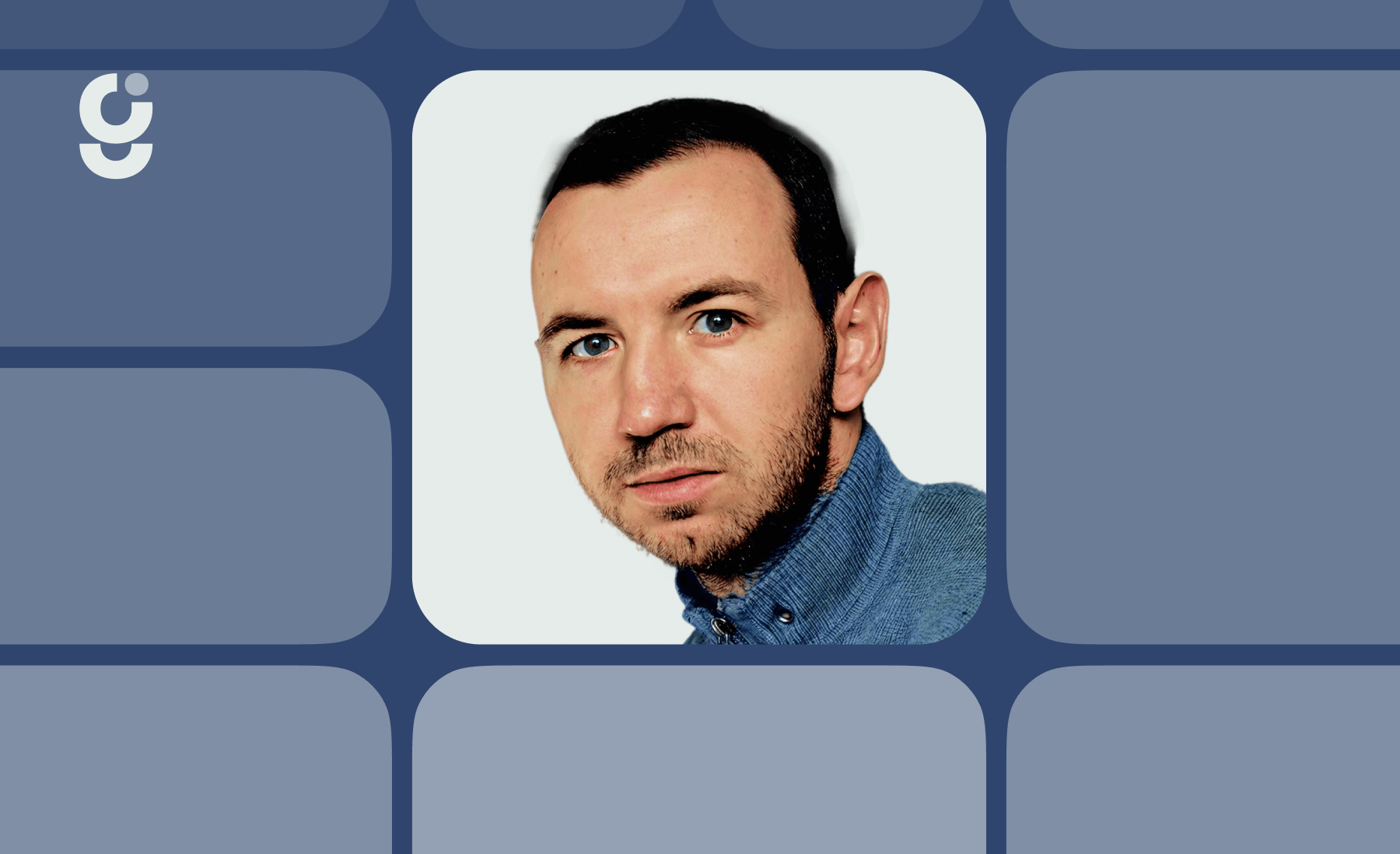
tl;dr: Matt Glickman, co-founder of Genesis Computing and former Goldman Sachs and Snowflake executive, joins Jon Krohn on the SuperDataScience Podcast to explain how AI agents are transforming data engineering, why February 2026 marked a turning point for enterprise AI, and what it means for companies to truly operate as AI-first organizations.
Matt Glickman spent nearly 25 years at Goldman Sachs running data platform teams before joining Snowflake in its early days. When he saw frontier AI models reach a new threshold of capability, he co-founded Genesis Computing with Justin Langston to build an agentic platform focused entirely on data engineering.
His through line across every role has been the same problem: there are never enough people who can bridge business understanding and technical execution. At Goldman, that gap created bottlenecks. At Snowflake, it drove the move to cloud-based scalability. At Genesis, it is the whole product. The platform deploys inside a client's own environment, crawls their databases, code repositories, and documentation, builds a living context graph of how their organization actually operates, and then uses that context to run complex data engineering workflows autonomously.
Matt describes what he calls the "February moment" of 2026, when the latest frontier models crossed a threshold where they could reliably handle multi-step, high-context tasks like those common in data engineering. He frames it as an event horizon: organizations that embrace this shift will pull ahead, and those that do not will fall behind faster than expected.
One of the clearest distinctions Matt makes is between a copilot model and a true agentic model. A copilot waits for a human to direct every step. Genesis flips that. The agents work through complex projects on their own and only come back to a human when their confidence is low, at which point the answer gets recorded so the same question never has to be asked again.
This matters especially for data engineering because so much institutional knowledge is undocumented. When someone leaves, the knowledge walks out with them. Genesis addresses this by building what Matt calls a living context graph during onboarding, mapping every database, every data relationship, every relevant process, so that nothing is lost when people move on.
On the question of jobs, Matt is direct: no one is losing their job, but junior hiring will slow. The engineers already on staff become significantly more productive, able to oversee work that would have previously required a larger team. The people who will stand out are those who can orchestrate multiple agents at once, what his co-founder Justin calls "spinning plates."
For enterprise customers in finance and healthcare, two industries that were slow to adopt cloud but fast to adopt AI, Genesis proves its case by showing results rather than making promises. The platform follows existing CI/CD pipelines, produces code reviews, runs in development before touching production, and documents everything. For a client managing 30,000 reports during a migration, Genesis can run and validate every single one. A human consulting team would sample a few hundred.
Matt Glickman's career has tracked the biggest platform shifts in enterprise data, from physical servers at Goldman to cloud at Snowflake to agents at Genesis. His argument is that the companies willing to ask "why can't an agent do this?" before defaulting to hiring will be the ones that compound knowledge, move faster, and survive what he sees as a real bifurcation in the market. For data teams specifically, agentic platforms are not a future possibility. According to Matt, they are already working.
Listen to the full episode at superdatascience.com/981.
What is Genesis Computing? Genesis Computing is an agentic platform built specifically for data engineering. It deploys inside a client's own environment, maps their data relationships, and uses AI agents to run complex workflows autonomously. Learn more at genesiscomputing.ai.
What is a living context graph? It is Genesis Computing's term for the internal knowledge map the system builds during onboarding. It connects databases, code, documentation, and communications to capture how a business actually operates, not just what is formally documented.
Will AI agents replace data engineers? Matt Glickman says no. Current employees keep their roles, but the platform allows each data engineer to handle significantly more work. Junior hiring may slow as a result, but those already in the field become more valuable, not redundant.
What was the "February moment" Matt referenced? Matt uses this phrase to describe February 2026, when the latest frontier AI models demonstrated the ability to handle complex, multi-step, context-heavy tasks at a level that previously required human expertise. He treats it as a point of no return for enterprise AI adoption.
How does Genesis Computing handle AI errors and hallucinations? The platform uses what Matt calls a harness: agents must prove their outputs with actual artifacts, not just claim completion. At every step, agents report their confidence level and escalate to a human when they are uncertain, rather than guessing.
The SuperDataScience Podcast, hosted by Jon Krohn, covers data science, machine learning, and AI through conversations with researchers, engineers, and founders. New episodes drop weekly. You can find show notes, transcripts, and related resources for this episode at superdatascience.com/981. Related episodes mentioned in this conversation include SDS 975 with Zack Kass and SDS 977 with Prof. Kyunghyun Cho.
.jpg)
.jpg)
.jpg)

.jpg)
.jpg)
.jpg)

.jpeg)
.png)
.png)
.png)
.png)
.png)
.jpeg)
%2520(1).png)
.jpg)

.jpeg)

%25201%2520(1).jpeg)
.jpg)
.png)
.jpeg)
.png)
.png)
.png)
.avif)




![Agent Server [1/3]: Where Enterprise AI Agents Live, Work, and Scale](https://cdn.prod.website-files.com/67bef0c56c3781a827a0f375/69c14b6f967d2ae5279adcea_690e4d0f068d3ec27aea7ae0_123%2520(1).png)
![Agent Server [2/3]: Where Should Your Agent Server Run?](https://cdn.prod.website-files.com/67bef0c56c3781a827a0f375/69c14b6f967d2ae5279adcf0_690e646b6e0366d090fbc37f_wdxczxgr-1.png)
![Agent Server [3/3]: Agent Access Control Explained: RBAC, Caller Limits, and Safer A2A](https://cdn.prod.website-files.com/67bef0c56c3781a827a0f375/69c14b56c87a1735a82bac8d_69132a45740300abc320bc7f_Cover_%2520RBAC%2520for%2520Agents%252C%2520Done%2520Right2%2520(1).png)


.png)


.jpg)