Anton Gorshkov

Head of Engineering
LinkedIn
Anton is a long-time engineering leader and systems thinker with over two decades of experience building mission-critical platforms in financial services. As a former Managing Director at Goldman Sachs, he led initiatives across Data Strategy for Asset Management, Portfolio Management and Trading Systems, Alternative Investments, and Quantitative Infrastructure — including a successful GS Accelerate incubator venture. Anton is known for combining hands-on technical depth with a talent for building high-impact teams. His leadership is grounded in deep engineering intuition, a passion for elegant system design, and a relentless focus on solving real business problems. At Genesis Computing, Anton brings that same energy to architecting next-generation agentic systems that augment data teams and accelerate enterprise intelligence.
July 14, 2026

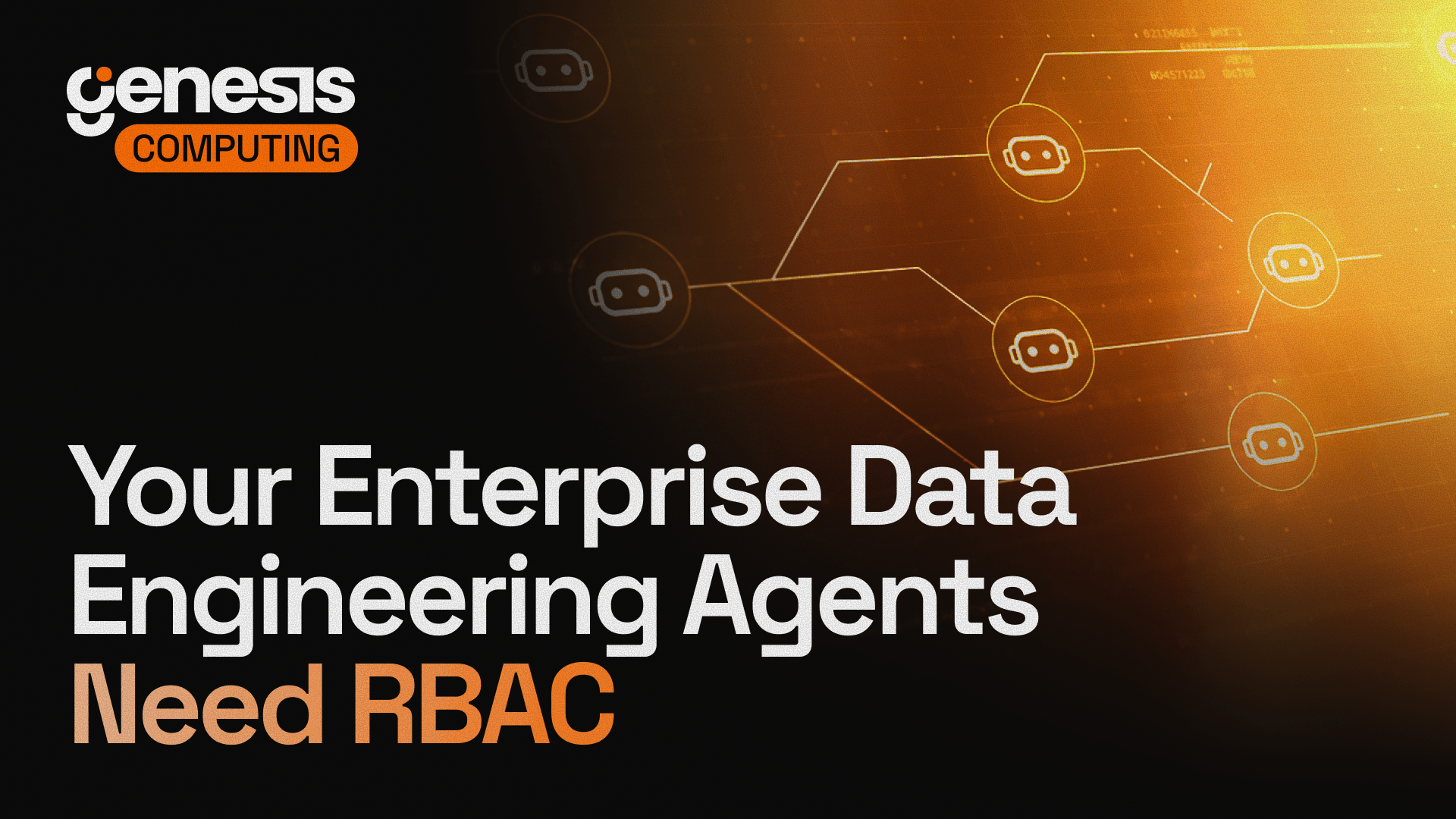
Your Enterprise Data Engineering Agents Need RBAC

Anton Gorshkov
Head of Engineering
Keep Reading
See all
Genesis Computing article cover about tokenflation in enterprise AI, showing an abstract orange architectural graphic and the headline “Tokenflation is a Symptom → The Cure is Architectural.”
Genesis Computing — Validated Technology Partner of Databricks. Dark background with warm orange gradient lighting. Genesis Computing logo in the top left corner
Genesis Computing Recognised in Gartner's "Data Engineering 2.0" Research
Why AI Agents That Have Context First Build Better Pipelines
What’s Actually Blocking Agentic Commerce for CPGs? Not AI. The Data Pipeline.
What Does $17.4M in Undetected Royalty Exposure Look Like? Eight Platforms. Fifty Titles. Zero Unified View.
From "Something's Broken" to Root Cause in 5 Minutes
40 Minutes to Reverse-Engineer a Legacy Data Warehouse (Including the Ghost Artifacts Nobody Knew Existed)
Meet Genesis Twin: The Digital Twin That Ends the Monday Morning Data Fire Drill
From Raw Claims Data to a Live Analytics Dashboard in 7 Minutes
Super Data Science: ML & AI Podcast with Jon Krohn
Connecting Data Sources in Genesis
The Death of Traditional BI - Part 1
Exploring Genesis UI: Agent Workflows
Exploring Genesis UI: Agents & Their Tool
Launching the Genesis App through the Snowflake Marketplace
Exploring Mission Features in Genesis UI
Delivering on agentic potential: how can financial services firms develop agents to add real value?
GXS Uses Autonomous AI Agents to Speed Data Engineering from Months to Hours
Enterprise AI Data Agents: Automating Bronze Layer to Snowflake dbt Pipelines
Stefan Williams, Snowflake & Matt Glickman, Genesis Computing | Snowflake Summit 2025
A CEO's Perspective on the Shift to AI Agents
Genesis Walkthrough #1: Exploring an S3 Bucket with Genesis Agents
Genesis Walkthrough #2: Loading data from S3 into Snowflake with Genesis
Genesis Walkthrough #3: Using a Blueprint to launch a mission
Genesis Walkthrough #4: Genesis Mission prompt for required information
Genesis Walkthrough #5: Checking in on a running mission
Genesis Walkthrough #6: Mission document flow
Genesis Walkthrough #7: Exploring Mission Results
Genesis Walkthrough #8: DBT Engineering Blueprint
From Requirements to Production Pipelines With Genesis Missions
Promotional banner for Genesis Computing
Matt Glickman gives an interview at Snowflake Summit 2025
The Future of Data Engineering: From Months to Hours with Agentic AI
Your Data Backlog Isn't Just a List — It's a Risk Ledger
Blueprints: How We Teach Agents to Work the Way Data Engineers Do
Context Management: The Hardest Problem in Long-Running Agents
Progressive Tool Use
Better Together: Genesis and Snowflake Cortex Agents API Integration
How Hard Could It Be? A Tale of Building an Enterprise Agentic Data Engineering Platform
20 Years at Goldman Taught Me How to Manage People. Turns Out, Managing AI Agents Isn't That Different.
Agent Server [1/3]: Where Enterprise AI Agents Live, Work, and Scale
Agent Server [2/3]: Where Should Your Agent Server Run?
Agent Server [3/3]: Agent Access Control Explained: RBAC, Caller Limits, and Safer A2A
The Junior Data Engineer is Now an AI Agent
Using AI Agents to Generate Synthetic Data
Automate Dashboard Creation with Genesis
3 Cortex Codes Running in Parallel?
How Genesis Automates Data Pipeline Development in Hours
Genesis Bronze, Silver, Gold Agentic Data Engineering: From Dashboard Sketch to Production Pipeline
The Evolution of Data Work: Introducing Agentic Data Engineering
AI Agent Builds dbt Analytics Schema in 30 Minutes
Replay
Stay in the Fast Lane
News and product updates in Agentic AI for enterprise data teams.
Thank you! Your submission has been received!
Oops! Something went wrong while submitting the form.

TL;DR: Genesis supports role-based access control for both people and agents. Administrators get fine-grained permissions over which agents a user can reach, which secrets they can touch, and which actions an agent is allowed to take on its own. As AI agents move from pilots into production data environments, that distinction between what a person can do and what an agent can do stops being optional.

Most conversations about AI agents in the enterprise focus on capability: what can the agent build and how fast. Fewer conversations focus on constraint: what should the agent never be allowed to do and who decides that. We treated the second question as a first-class design problem from the start, not something bolted on before a security review. 

When a user asks an agent to use a credential, Genesis checks that both the user and the agent independently have access — not just the agent.

Two Kinds of Identity, One Permission Model

Genesis administrators get fine-grained control over what a particular user, or set of users, can and cannot do inside the platform. That part is familiar. Most enterprise software has some version of user-level RBAC by now, and we cover how that shows up across the product in Exploring the Genesis UI: Understanding Agents and Their Tools.

What is less common is that agents get the same treatment. In Genesis, both users and agents have roles, and those roles carry a set of permissions and actions they are allowed to take. For a user, that includes which agents they have access to and whether they can see or use particular secrets. For an agent, it includes which systems it can touch and which actions it can execute autonomously.

This matters because an AI agent working inside a production data warehouse is not a read-only chatbot. It can create tables, write pipelines, execute code, and push changes to a Git repository. We go deeper into where that execution actually happens, and why it needs its own governance layer, in our three-part series on where enterprise AI agents live, work, and scale.

The Governance Gap Most Teams Don't See Coming

Security researchers tracking enterprise AI deployments have flagged a consistent pattern: teams move fast on agent capability and slower on agent governance. The gap between those two speeds is where incidents happen. A recent AI agent security analysis from Beam found a wide split between how confident executives feel about their access policies and how much visibility their security teams actually have into what agents can reach and which tools they call.

Government guidance points the same direction. The NIST AI Risk Management Framework treats access governance as one of the foundational controls for any AI system operating on sensitive data, not something layered on after deployment.

For data engineering specifically, this shows up in a concrete way. An agent building a migration pipeline needs write access to staging tables. It should not have standing write access to production reporting tables a finance team depends on for close. Without role-based scoping, that boundary depends on the agent behaving well. With it, the boundary is enforced by the platform whether the agent chooses to respect it or not.

The platform enforces this by scoping which connections the agent can use, and each connection authenticates as a database role with only the privileges it needs.

What Fine-Grained Actually Means in Practice

Fine-grained permissioning for agents goes well past on or off. It covers which systems an agent can connect to, which secrets it can retrieve, which actions it can execute autonomously versus which require a human review checkpoint, and which users are permitted to assign it those capabilities.

That last point matters more than it sounds. A permission model that only governs the agent, and not who is allowed to configure the agent, leaves a gap. Genesis extends role-based control to both layers: what the agent can do, and who can change what the agent can do. I’ve written about the parallels to managing human teams in How Hard Could It Be? A Tale of Building an Enterprise Agentic Data Engineering Platform, where the permission questions turned out to be just as hard as the capability questions.

Why This Matters More as Agents Get More Autonomous

The more autonomous an agent becomes, the more its permission boundaries do the work a human reviewer used to do. Early AI tools that only drafted a query for a person to approve did not need much access control, because someone checked every step. Agents that plan and execute multi-step migrations end to end need permission boundaries that hold up without a person watching every action in real time.

That is the practical argument for RBAC in agentic data engineering. It is not a compliance checkbox. It is what makes it possible to let an agent run unattended on a real migration without gambling on its judgment alone.

Frequently Asked Questions

Does Genesis support role-based access control for AI agents, not just users? Yes. Both users and agents have roles in Genesis, each with a defined set of permissions and allowed actions.

What can administrators control with Genesis RBAC? Which agents a user can access, which secrets they can use, and which actions an agent is permitted to take autonomously.

Why does RBAC matter more for AI agents than for typical software? Agents can take autonomous actions like writing pipelines or modifying tables, so permission boundaries have to be enforced by the platform rather than relying on the agent to behave well.

Is agent-level RBAC required for regulatory compliance? Frameworks like the NIST AI Risk Management Framework treat access governance as a foundational control for AI systems handling sensitive data, even though adoption itself is voluntary.


Transcript
Show more

Want to learn more? Get in touch!

Experience what Genesis can do for your team.
Request a Demo
Stay in the Fast Lane
News and product updates in Agentic AI for enterprise data teams.
Thank you! Your submission has been received!
Oops! Something went wrong while submitting the form.

Keep Reading

Exploring Mission Features in Genesis UI
Exploring Genesis UI: Agents & Their Tool
Meet Genesis Twin: The Digital Twin That Ends the Monday Morning Data Fire Drill
Using AI Agents to Generate Synthetic Data
View All Articles
July 16, 2026
The Agentic Control Plane for Data Engineering
Genesis Computing
July 9, 2026
How Genesis Missions Collapse Enterprise Data Work From Months to Hours
Anton Gorshkov
July 2, 2026
How Genesis Blueprints Make AI Outcomes Repeatable
Genesis Computing
Genesis Computing article cover about tokenflation in enterprise AI, showing an abstract orange architectural graphic and the headline “Tokenflation is a Symptom → The Cure is Architectural.”
June 18, 2026
Tokenflation Is a Symptom. The Cure Is Context-Aware AI Architecture
Genesis Computing
Genesis Computing — Validated Technology Partner of Databricks. Dark background with warm orange gradient lighting. Genesis Computing logo in the top left corner
June 11, 2026
Genesis Computing Announced as Validated Technology Partner of Databricks
Yahoo Finance
Genesis Computing Recognised in Gartner's "Data Engineering 2.0" Research
May 29, 2026
Genesis Computing Recognised in Gartner's "Data Engineering 2.0" Research
Yahoo Finance
Why AI Agents That Have Context First Build Better Pipelines
May 12, 2026
Why AI Agents That Have Context First Build Better Pipelines
Genesis Computing
What’s Actually Blocking Agentic Commerce for CPGs? Not AI. The Data Pipeline.
May 5, 2026
What’s Actually Blocking Agentic Commerce for CPGs? Not AI. The Data Pipeline.
Genesis Computing
What Does $17.4M in Undetected Royalty Exposure Look Like? Eight Platforms. Fifty Titles. Zero Unified View.
May 5, 2026
What Does $17.4M in Undetected Royalty Exposure Look Like? Eight Platforms. Fifty Titles. Zero Unified View.
Genesis Computing
From "Something's Broken" to Root Cause in 5 Minutes
April 27, 2026
From "Something's Broken" to Root Cause in 5 Minutes
No items found.
No items found.
40 Minutes to Reverse-Engineer a Legacy Data Warehouse (Including the Ghost Artifacts Nobody Knew Existed)
April 23, 2026
40 Minutes to Reverse-Engineer a Legacy Data Warehouse (Including the Ghost Artifacts Nobody Knew Existed)
Genesis Computing
From Raw Claims Data to a Live Analytics Dashboard in 7 Minutes
April 22, 2026
From Raw Claims Data to a Live Analytics Dashboard in 7 Minutes
Genesis Computing
Meet Genesis Twin: The Digital Twin That Ends the Monday Morning Data Fire Drill
April 20, 2026
Meet Genesis Twin: The Digital Twin That Ends the Monday Morning Data Fire Drill
Genesis Computing
Super Data Science: ML & AI Podcast with Jon Krohn
April 9, 2026
Super Data Science: ML & AI Podcast with Jon Krohn
Matt Glickman
Connecting Data Sources in Genesis
April 8, 2026
Connecting Data Sources in Genesis
Todd Beauchene
Promotional banner for Genesis Computing
March 31, 2026
How Genesis Automates Synthetic Data Generation for Databricks Dev Environments in Under 34 Minutes
Todd Beauchene
The Death of Traditional BI - Part 1
March 19, 2026
The Death of Traditional BI - Part 1
Genesis Computing
AI Agent Builds dbt Analytics Schema in 30 Minutes
March 11, 2026
AI Agent Builds dbt Analytics Schema in 30 Minutes
Todd Beauchene
Genesis Bronze, Silver, Gold Agentic Data Engineering: From Dashboard Sketch to Production Pipeline
February 26, 2026
Genesis Bronze, Silver, Gold Agentic Data Engineering: From Dashboard Sketch to Production Pipeline
Genesis Computing
How Genesis Automates Data Pipeline Development in Hours
February 19, 2026
How Genesis Automates Data Pipeline Development in Hours
Genesis Computing
3 Cortex Codes Running in Parallel?
February 12, 2026
3 Cortex Codes Running in Parallel?
Justin Langseth
February 10, 2026
Powering Up Cortex Code with Genesis Superpowers
Matt Glickman
Automate Dashboard Creation with Genesis
February 2, 2026
Automate Dashboard Creation with Genesis
Justin Langseth
Using AI Agents to Generate Synthetic Data
January 27, 2026
Using AI Agents to Generate Synthetic Data
Justin Langseth
The Junior Data Engineer is Now an AI Agent
January 12, 2026
The Junior Data Engineer is Now an AI Agent
Matt Glickman
From Requirements to Production Pipelines With Genesis Missions
December 22, 2025
From Requirements to Production Pipelines With Genesis Missions
Genesis Computing
20 Years at Goldman Taught Me How to Manage People. Turns Out, Managing AI Agents Isn't That Different.
December 4, 2025
20 Years at Goldman Taught Me How to Manage People. Turns Out, Managing AI Agents Isn't That Different.
Anton Gorshkov
A CEO's Perspective on the Shift to AI Agents
December 2, 2025
A CEO's Perspective on the Shift to AI Agents
Genesis Computing
Genesis Walkthrough #1: Exploring an S3 Bucket with Genesis Agents
December 2, 2025
Genesis Walkthrough #1: Exploring an S3 Bucket with Genesis Agents
Todd Beauchene
Genesis Walkthrough #2: Loading data from S3 into Snowflake with Genesis
December 2, 2025
Genesis Walkthrough #2: Loading data from S3 into Snowflake with Genesis
Todd Beauchene
Genesis Walkthrough #3: Using a Blueprint to launch a mission
December 2, 2025
Genesis Walkthrough #3: Using a Blueprint to launch a mission
Todd Beauchene
Genesis Walkthrough #4: Genesis Mission prompt for required information
December 2, 2025
Genesis Walkthrough #4: Genesis Mission prompt for required information
Todd Beauchene
Genesis Walkthrough #5: Checking in on a running mission
December 2, 2025
Genesis Walkthrough #5: Checking in on a running mission
Todd Beauchene
Genesis Walkthrough #6: Mission document flow
December 2, 2025
Genesis Walkthrough #6: Mission document flow
Todd Beauchene
Genesis Walkthrough #7: Exploring Mission Results
December 2, 2025
Genesis Walkthrough #7: Exploring Mission Results
Todd Beauchene
Genesis Walkthrough #8: DBT Engineering Blueprint
December 2, 2025
Genesis Walkthrough #8: DBT Engineering Blueprint
Todd Beauchene
Exploring Genesis UI: Agents & Their Tool
November 7, 2025
Exploring Genesis UI: Agents & Their Tool
Todd Beauchene
Launching the Genesis App through the Snowflake Marketplace
November 7, 2025
Launching the Genesis App through the Snowflake Marketplace
Todd Beauchene
Exploring Mission Features in Genesis UI
November 7, 2025
Exploring Mission Features in Genesis UI
Todd Beauchene
How Hard Could It Be? A Tale of Building an Enterprise Agentic Data Engineering Platform
November 6, 2025
How Hard Could It Be? A Tale of Building an Enterprise Agentic Data Engineering Platform
Anton Gorshkov
Better Together: Genesis and Snowflake Cortex Agents API Integration
November 4, 2025
Better Together: Genesis and Snowflake Cortex Agents API Integration
Genesis Computing
Exploring Genesis UI: Agent Workflows
October 31, 2025
Exploring Genesis UI: Agent Workflows
Todd Beauchene
Agent Server [1/3]: Where Enterprise AI Agents Live, Work, and Scale
October 27, 2025
Agent Server [1/3]: Where Enterprise AI Agents Live, Work, and Scale
Justin Langseth
Agent Server [2/3]: Where Should Your Agent Server Run?
October 27, 2025
Agent Server [2/3]: Where Should Your Agent Server Run?
Justin Langseth
Agent Server [3/3]: Agent Access Control Explained: RBAC, Caller Limits, and Safer A2A
October 27, 2025
Agent Server [3/3]: Agent Access Control Explained: RBAC, Caller Limits, and Safer A2A
Justin Langseth
Delivering on agentic potential: how can financial services firms develop agents to add real value?
October 26, 2025
Delivering on agentic potential: how can financial services firms develop agents to add real value?
Genesis Computing
Blueprints: How We Teach Agents to Work the Way Data Engineers Do
October 20, 2025
Blueprints: How We Teach Agents to Work the Way Data Engineers Do
Justin Langseth
Context Management: The Hardest Problem in Long-Running Agents
October 20, 2025
Context Management: The Hardest Problem in Long-Running Agents
Justin Langseth
Progressive Tool Use
October 20, 2025
Progressive Tool Use
Genesis Computing
Your Data Backlog Isn't Just a List — It's a Risk Ledger
August 22, 2025
Your Data Backlog Isn't Just a List — It's a Risk Ledger
Genesis Computing
The Future of Data Engineering: From Months to Hours with Agentic AI
August 14, 2025
The Future of Data Engineering: From Months to Hours with Agentic AI
Genesis Computing
Matt Glickman gives an interview at Snowflake Summit 2025
June 27, 2025
Ex-Snowflake execs launch Genesis Computing to ease data pipeline burnout with AI agents
Genesis Computing
GXS Uses Autonomous AI Agents to Speed Data Engineering from Months to Hours
June 25, 2025
GXS Uses Autonomous AI Agents to Speed Data Engineering from Months to Hours
Genesis Computing
Enterprise AI Data Agents: Automating Bronze Layer to Snowflake dbt Pipelines
June 5, 2025
Enterprise AI Data Agents: Automating Bronze Layer to Snowflake dbt Pipelines
Genesis Computing
Stefan Williams, Snowflake & Matt Glickman, Genesis Computing | Snowflake Summit 2025
June 4, 2025
Stefan Williams, Snowflake & Matt Glickman, Genesis Computing | Snowflake Summit 2025
Genesis Computing
The Evolution of Data Work: Introducing Agentic Data Engineering
Matt Glickman
Justin Langseth