


July 21, 2026
A Living Memory of Your Enterprise Context — The Genesis Context Graph
.jpg)

.png)
TL;DR: Traditional data engineering is slow, manual, and expensive. GXS Bank, Singapore's first digital bank, partnered with Genesis to deploy a multi-agent platform directly inside Snowflake. The result: projects that once took months now finish in hours. This post breaks down how the Genesis agent pipeline works, what GXS achieved, and what it means for data teams ready to move faster.
Every day a data pipeline sits in development, there's a business impact. Critical financial reporting, new product launches, and other strategic initiatives all depend on the speed and reliability of your data infrastructure.
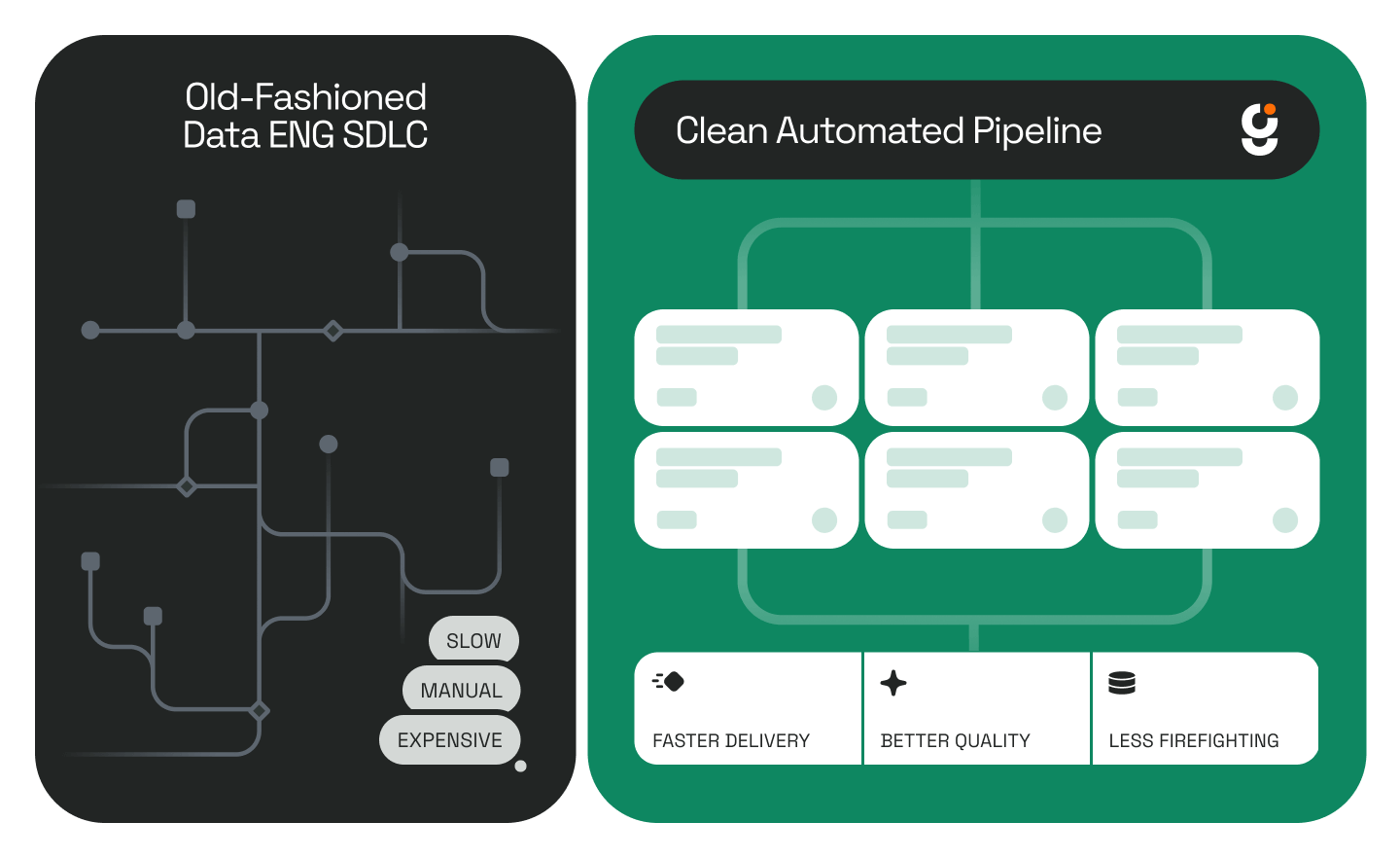
Historically, data engineering has been a bottleneck, costing months of manual effort and delaying time-to-market. Applying autonomous data agents to your data engineering challenges can break that bottleneck, empowering you to reclaim that lost time and accelerate your most critical business initiatives.
Data engineering has always been notoriously complex, resource-intensive, and time-consuming. Organizations often grapple with disparate data sources, unclear or incomplete documentation, and heavy reliance on manual processes. Data engineers frequently spend months painstakingly mapping data sources, writing custom transformation logic, validating pipelines, and ensuring quality, all while contending with frequent changes and undocumented institutional knowledge.
If this sounds familiar, you're not alone. Read more about why the data backlog isn't just a list, it's a risk ledger.
GXS Bank, Singapore's first digital bank, saw these traditional limitations as an opportunity. With a mission to make banking better and more accessible, GXS committed to a fully digital, data-driven approach. Their goal was not merely to improve processes but to radically reimagine data engineering.
The bank built a central data ecosystem, ingesting data every 15 minutes from over 100 systems directly into Snowflake. This eliminated silos and provided a single source of truth, enabling them to rapidly innovate across regulatory reporting, financial analytics, compliance, and beyond.
Watch the full session as featured during Snowflake Summit 2025.
GXS's commitment to innovation led them to partner with Genesis, a multi-agent platform integrated directly within their Snowflake environment. Agentic data engineering uses autonomous, specialized agents, each focused on a distinct role, to automate the repetitive, time-consuming work that bogs down data teams.
These agents work alongside human engineers by automating repetitive tasks, synthesizing complex research, and rapidly generating accurate code. The engineers stay in control; the agents handle the grind.
For a deeper look at how this represents a fundamental shift in the craft, see The Evolution of Data Work: Introducing Agentic Data Engineering.
Here is how the Genesis platform transformed GXS Bank's data engineering lifecycle:
1. PM Agent initiates the process, breaking complex projects into clear, manageable tasks and assigning them to specialized agents.
2. Source Research Agent conducts deep research into existing data resources and prior project logic, then generates comprehensive documentation, eliminating the burden of manual research and tribal knowledge loss.
3. Data Engineering Agent translates research and mappings into executable dbt code. It learns from the existing codebase to ensure consistency and accuracy aligned with the bank's established coding standards.
4. QA Agent validates the generated pipelines using synthetic data, testing scenarios and surfacing issues before any human intervention is needed.
Want to see this in action step by step? The Genesis Walkthrough series covers the full pipeline from source exploration to dbt blueprint.
The results at GXS Bank were immediate. Projects that historically took months to deliver are now completed in hours. By shifting to agentic data engineering, GXS Bank is now able to:
For more on the GXS story, read the full GXS case study.
Importantly, the shift to agentic data engineering didn't require human teams to overhaul how they work. Genesis agents integrated with existing workflows and familiar tools like Google Sheets and Jira, ensuring that technology adapted to people, not the other way around.
Human input became strategic rather than administrative. Engineers answer targeted questions from agents only when genuine ambiguity arises. Each interaction enriches the agents' knowledge base, continuously improving future automation capabilities.
This is the vision behind How Genesis Automates Data Pipeline Development in Hours, and why it's built to fit the way data teams already operate.
Agentic data engineering isn’t just an incremental step; it’s a paradigm shift. It unlocks the full potential of data teams by transforming cumbersome manual processes into streamlined, automated workflows. At GXS Bank, this shift revolutionized their approach to innovation.
GXS Bank's experience shows what's possible when you stop accepting the bottleneck as a given. Organizations ready to accelerate their data transformation should take a close look at what agentic platforms make possible today.
Curious about how Genesis would fit your stack? Explore deployments on Snowflake, AWS, Azure, and Databricks.
What is agentic data engineering? Agentic data engineering uses specialized, autonomous software agents to handle distinct stages of the data pipeline lifecycle: research, mapping, code generation, and quality assurance, with minimal manual intervention. Unlike traditional tools that assist engineers, these agents execute end-to-end workflows on their own.
How is Genesis different from a coding assistant like Copilot or Cursor? Coding assistants suggest or write code snippets that an engineer then reviews and executes. Genesis agents go further: they research the data source, map transformations, generate and run pipeline code, write documentation, execute tests, and monitor for errors; handling the full workflow, not just the coding step.
Does Genesis replace data engineers? No. Genesis is designed to augment data engineers, not replace them. Engineers retain oversight and answer questions when agents encounter genuine ambiguity. The goal is to remove the repetitive, low-value work so engineers can focus on architecture, strategy, and higher-impact problems.
Is Genesis secure? What happens to our data? Genesis runs as a native app inside your Snowflake environment, which means your data never leaves your existing infrastructure. It inherits your current Snowflake security posture, including SOC 2, HIPAA, and GDPR controls where applicable.
What data stacks does Genesis support? Genesis integrates with Snowflake, BigQuery, Redshift, Azure Fabric, Databricks, dbt, Airflow, Jira, GitHub, and more. See the full list of deployments.
How long does it take to get started? GXS Bank saw results immediately after deployment. During onboarding, Genesis agents connect to your repositories, databases, and tools to build a context graph of your data environment so agents are informed before they start working.

.jpg)
.jpg)
.jpg)

.jpeg)
.png)
.png)
.png)
.png)
.png)
.jpeg)
.jpeg)
.jpeg)
.jpg)
%2520(1).png)
.jpg)

.jpeg)
%25201%2520(1).jpeg)
%25201%2520(1).jpeg)
.jpg)

.png)
.jpeg)
.png)
.png)
.png)
.avif)





![Agent Server [1/3]: Where Enterprise AI Agents Live, Work, and Scale](https://cdn.prod.website-files.com/67bef0c56c3781a827a0f375/69c14b6f967d2ae5279adcea_690e4d0f068d3ec27aea7ae0_123%2520(1).png)
![Agent Server [2/3]: Where Should Your Agent Server Run?](https://cdn.prod.website-files.com/67bef0c56c3781a827a0f375/69c14b6f967d2ae5279adcf0_690e646b6e0366d090fbc37f_wdxczxgr-1.png)
![Agent Server [3/3]: Agent Access Control Explained: RBAC, Caller Limits, and Safer A2A](https://cdn.prod.website-files.com/67bef0c56c3781a827a0f375/69c14b56c87a1735a82bac8d_69132a45740300abc320bc7f_Cover_%2520RBAC%2520for%2520Agents%252C%2520Done%2520Right2%2520(1).png)



.png)


.jpeg)