May 20, 2026

Gartner Names Genesis Computing as a Recommended Vendor. Here's What That Means for Your AI Roadmap.

Genesis Computing
Stay in the Fast Lane
News and product updates in Agentic AI for enterprise data teams.
Thank you! Your submission has been received!
Oops! Something went wrong while submitting the form.

TL;DR: Gartner's latest data and analytics research identifies three constraints blocking enterprise AI projects. Genesis Computing was named a recommended vendor for teams addressing all three. Here's what that means in practice.

The Problem Everyone's Facing

Most data engineering teams are dealing with the same pressure. They've invested in modern platforms, hired talented engineers, built reliable pipelines; and yet, when AI projects land on the roadmap, everything stalls.

The bottleneck is rarely what it looks like from the outside. It's architectural. Gartner's 2026 data and analytics trends research put a name to what teams have been experiencing: the leading barriers to AI deployment are now structural, not organizational. Being listed among Gartner's recommended vendors means Genesis is solving a recognized, documented problem.

Three Barriers Blocking Your AI Projects (And Why They're Hard to Fix)

1. Your Data Team Is Drowning in Manual Work

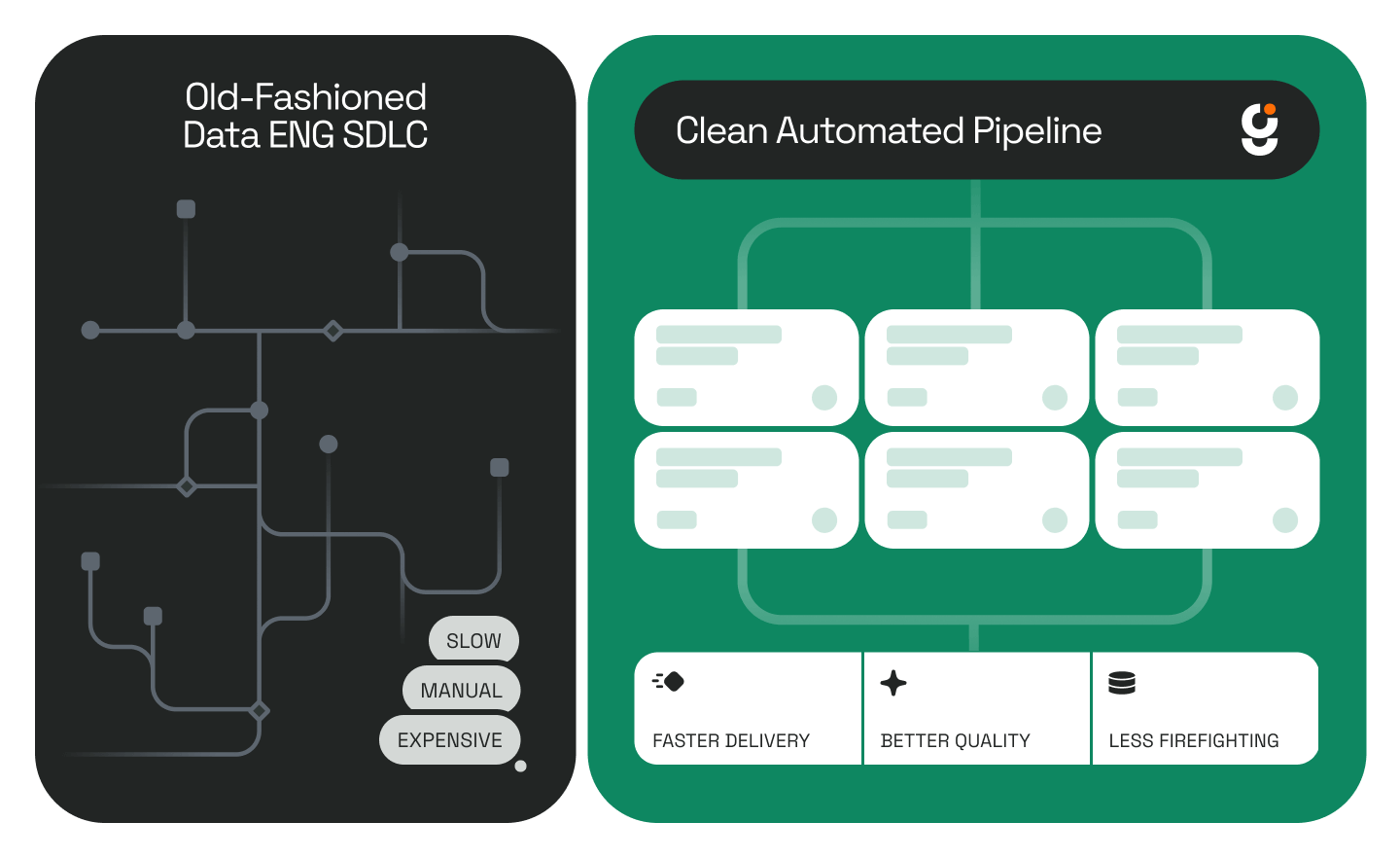
Think about how your team actually builds data pipelines today: writing transformation scripts by hand, monitoring jobs and fixing failures manually, discovering data quality issues in production, reverse-engineering legacy pipelines for documentation.

This was fine five years ago. Today it's a bottleneck. AI projects need fresh, clean, trustworthy data continuously. Manual processes can't keep up.

Genesis Data Agents automate what your team is currently doing by hand, freeing engineers to do actual engineering instead of babysitting pipelines. GrowthZone's four-person team scaled from 10 customer migrations per year to a projected 30 to 50 -- with no new headcount -- after deploying Genesis natively inside Snowflake. Engineering time per milestone dropped from 20 days to one.

For more on what that looks like in practice: How Genesis Automates Data Pipeline Development in Hours.

2. Your Data Doesn't Know What It Means

Your data warehouse has a schema. It tells you what data is:

INSERT

But it doesn't tell you why that data matters -- which customers are significant, which amounts are meaningful, what the relationships between fields imply. For traditional reports, that's fine. Humans read the output and fill in the context.

When you're deploying autonomous agents -- systems that are supposed to reason about your data and take action -- missing context is catastrophic. The agent doesn't understand which relationships matter. It hallucinates. It fails in production.

Gartner's 2026 research specifically flags the "need for context" as a defining challenge this year. The problem isn't the models. It's what the models are given to work with.

Genesis builds semantic understanding into how it operates against your data from the first interaction. Agents aren't guessing -- they're working within business context that was defined upfront. See also: Why AI Agents That Have Context First Build Better Pipelines.

3. Your Infrastructure Was Built for Yesterday's Problems

Your data stack was optimized to move structured data from A to B on a schedule. ETL tools are good at that. But autonomous systems need something different: unstructured data handled natively, near-real-time updates instead of nightly batches, semantic preparation for downstream reasoning, and auditable lineage at every step.

Your current tools weren't designed for this. The New Stack's analysis of data engineering in 2026 frames the shift plainly: engineers are moving from pipeline builders to architects who supervise automated systems. That transition only happens if the infrastructure underneath supports it.

So What Does It Actually Look Like to Fix This?

You need automation that understands context, not just rules

Instead of engineers hand-writing transformation logic, you need systems that understand what you're trying to do and execute accordingly -- learning from what happens, handling edge cases intelligently, operating within your existing environment without a parallel infrastructure build. The dbt Engineering Blueprint walkthrough shows what this looks like end to end.

You need your data to understand your business

Your infrastructure needs a layer that encodes your business logic -- what data is trustworthy for which use cases, how datasets relate to each other, which governance rules apply. When agents have access to this, they stop hallucinating and make decisions grounded in your actual context. Genesis builds this in rather than bolting it on later. Related: Blueprints: How We Teach Agents to Work the Way Data Engineers Do.

You need to handle unstructured data at scale

A lot of valuable context lives in documents, emails, transcripts, and PDFs. Getting that data ready for downstream use is tedious work most current tools can't do natively. Genesis handles it with full lineage, so you know where every piece of context came from. A concrete example: From Raw Claims Data to a Live Analytics Dashboard in 7 Minutes.

Why This Matters Right Now

The companies that fix these three barriers first will have a structural advantage that's hard to replicate later. Everyone else will keep hiring more engineers to manage work that shouldn't require human attention, keep shipping agents that fail in production because the data context is missing, and keep rebuilding infrastructure that wasn't designed for what they're asking it to do.

Gartner's 2026 predictions for data and analytics make this explicit: AI-native organizations are achieving outsized growth efficiency by focusing on engineers who can adapt quickly, rather than scaling headcount to compensate for manual bottlenecks. Their recommendation of Genesis gives you a clear path forward instead of figuring it out alone.

Where to Start

  1. Have an honest conversation with your data team. Ask them: what are we spending time on that shouldn't require human effort? What would you build if you had three extra engineers? What's blocking your AI projects? Most teams will point to the same three things Gartner identified.
  2. Look for solutions that address all three layers. Fixing one in isolation creates a different bottleneck. Fast pipelines don't help if agents lack context. Rich context doesn't help if the infrastructure still runs on nightly batches.
  3. Start with one specific win. Pick the most painful manual process your team deals with every week. Automate it. Measure the result. Then scale.

Genesis is available for enterprise deployment on Snowflake, Databricks, AWS, Azure, and Docker. Documentation is at docs.genesiscomputing.com. To evaluate Genesis for your team: genesiscomputing.com/request-a-demo.

Frequently Asked Questions

What does it mean for Gartner to name Genesis Computing as a recommended vendor? Gartner evaluates vendors based on fit with documented enterprise needs. A named recommendation indicates they assessed Genesis as a credible solution for the data engineering automation and agentic workflow challenges their research identifies.

How does Genesis address the data context problem? Genesis maps your business context: relationships between datasets, governance rules, meaningful thresholds, before executing any pipeline work, and operates within that context automatically. More detail: Why AI Agents That Have Context First Build Better Pipelines.

Can a small data engineering team support enterprise AI projects without adding headcount? Yes, with the right work automated. GrowthZone's four-person team scaled from 10 to a projected 30 to 50 data migrations per year without adding headcount. Engineering execution was automated; customer review stayed human.

Want to learn more? Get in touch!

Experience what Genesis can do for your team.
Request a Demo
Stay in the Fast Lane
News and product updates in Agentic AI for enterprise data teams.
Thank you! Your submission has been received!
Oops! Something went wrong while submitting the form.

Keep Reading

Genesis Walkthrough #2: Loading data from S3 into Snowflake with Genesis
Delivering on agentic potential: how can financial services firms develop agents to add real value?
Better Together: Genesis and Snowflake Cortex Agents API Integration
Agent Server [2/3]: Where Should Your Agent Server Run?
View All Articles
May 20, 2026
Gartner Names Genesis Computing as a Recommended Vendor. Here's What That Means for Your AI Roadmap.
Genesis Computing
May 12, 2026
Why AI Agents That Have Context First Build Better Pipelines
Genesis Computing
May 5, 2026
What’s Actually Blocking Agentic Commerce for CPGs? Not AI. The Data Pipeline.
Genesis Computing
May 5, 2026
What Does $17.4M in Undetected Royalty Exposure Look Like? Eight Platforms. Fifty Titles. Zero Unified View.
Genesis Computing
April 27, 2026
From "Something's Broken" to Root Cause in 5 Minutes
No items found.
No items found.
April 23, 2026
40 Minutes to Reverse-Engineer a Legacy Data Warehouse (Including the Ghost Artifacts Nobody Knew Existed)
Genesis Computing
April 22, 2026
From Raw Claims Data to a Live Analytics Dashboard in 7 Minutes
Genesis Computing
April 20, 2026
Meet Genesis Twin: The Digital Twin That Ends the Monday Morning Data Fire Drill
Genesis Computing
April 9, 2026
Super Data Science: ML & AI Podcast with Jon Krohn
Matt Glickman
April 8, 2026
Connecting Data Sources in Genesis
Todd Beauchene
Promotional banner for Genesis Computing
March 31, 2026
How Genesis Automates Synthetic Data Generation for Databricks Dev Environments in Under 34 Minutes
Todd Beauchene
March 19, 2026
The Death of Traditional BI - Part 1
Genesis Computing
March 11, 2026
AI Agent Builds dbt Analytics Schema in 30 Minutes
Todd Beauchene
February 26, 2026
Genesis Bronze, Silver, Gold Agentic Data Engineering: From Dashboard Sketch to Production Pipeline
Genesis Computing
February 19, 2026
How Genesis Automates Data Pipeline Development in Hours
Genesis Computing
February 12, 2026
3 Cortex Codes Running in Parallel?
Justin Langseth
February 10, 2026
Powering Up Cortex Code with Genesis Superpowers
Matt Glickman
February 2, 2026
Automate Dashboard Creation with Genesis
Justin Langseth
January 27, 2026
Using AI Agents to Generate Synthetic Data
Justin Langseth
January 12, 2026
The Junior Data Engineer is Now an AI Agent
Matt Glickman
December 22, 2025
From Requirements to Production Pipelines With Genesis Missions
Genesis Computing
December 4, 2025
20 Years at Goldman Taught Me How to Manage People. Turns Out, Managing AI Agents Isn't That Different.
Anton Gorshkov
December 2, 2025
A CEO's Perspective on the Shift to AI Agents
Genesis Computing
December 2, 2025
Genesis Walkthrough #1: Exploring an S3 Bucket with Genesis Agents
Todd Beauchene
December 2, 2025
Genesis Walkthrough #2: Loading data from S3 into Snowflake with Genesis
Todd Beauchene
December 2, 2025
Genesis Walkthrough #3: Using a Blueprint to launch a mission
Todd Beauchene
December 2, 2025
Genesis Walkthrough #4: Genesis Mission prompt for required information
Todd Beauchene
December 2, 2025
Genesis Walkthrough #5: Checking in on a running mission
Todd Beauchene
December 2, 2025
Genesis Walkthrough #6: Mission document flow
Todd Beauchene
December 2, 2025
Genesis Walkthrough #7: Exploring Mission Results
Todd Beauchene
December 2, 2025
Genesis Walkthrough #8: DBT Engineering Blueprint
Todd Beauchene
November 7, 2025
Exploring Genesis UI: Agents & Their Tool
Todd Beauchene
November 7, 2025
Launching the Genesis App through the Snowflake Marketplace
Todd Beauchene
November 7, 2025
Exploring Mission Features in Genesis UI
Todd Beauchene
November 6, 2025
How Hard Could It Be? A Tale of Building an Enterprise Agentic Data Engineering Platform
Anton Gorshkov
November 4, 2025
Better Together: Genesis and Snowflake Cortex Agents API Integration
Genesis Computing
October 31, 2025
Exploring Genesis UI: Agent Workflows
Todd Beauchene
October 27, 2025
Agent Server [1/3]: Where Enterprise AI Agents Live, Work, and Scale
Justin Langseth
October 27, 2025
Agent Server [2/3]: Where Should Your Agent Server Run?
Justin Langseth
October 27, 2025
Agent Server [3/3]: Agent Access Control Explained: RBAC, Caller Limits, and Safer A2A
Justin Langseth
October 26, 2025
Delivering on agentic potential: how can financial services firms develop agents to add real value?
Genesis Computing
October 20, 2025
Blueprints: How We Teach Agents to Work the Way Data Engineers Do
Justin Langseth
October 20, 2025
Context Management: The Hardest Problem in Long-Running Agents
Justin Langseth
October 20, 2025
Progressive Tool Use
Genesis Computing
August 22, 2025
Your Data Backlog Isn't Just a List — It's a Risk Ledger
Genesis Computing
August 14, 2025
The Future of Data Engineering: From Months to Hours with Agentic AI
Genesis Computing
Matt Glickman gives an interview at Snowflake Summit 2025
June 27, 2025
Ex-Snowflake execs launch Genesis Computing to ease data pipeline burnout with AI agents
Genesis Computing
June 25, 2025
GXS Uses Autonomous AI Agents to Speed Data Engineering from Months to Hours
Genesis Computing
June 5, 2025
Enterprise AI Data Agents: Automating Bronze Layer to Snowflake dbt Pipelines
Genesis Computing
June 4, 2025
Stefan Williams, Snowflake & Matt Glickman, Genesis Computing | Snowflake Summit 2025
Genesis Computing
The Evolution of Data Work: Introducing Agentic Data Engineering
Matt Glickman
Justin Langseth